To illuminate the wall evenly across its full surface, two 120 cm LED Wall Spot — LED Plant Lamp by Venso fixtures are used, mounted on the ceiling parallel to the wall.
Fixture Specifications
| Parameter | Value |
|---|---|
| Power | 20–50 W (depending on length) |
| Input voltage | 90–245 VAC, 50–60 Hz |
| Spectrum | Full spectrum white (GrowWhite), 380–730 nm |
| PPFD | 145 µmol·m⁻²·s⁻¹ at 1 m / 905 µmol·m⁻²·s⁻¹ at 20 cm |
| Beam angle (this installation) | 60° |
| Colour temperature | Neutral white |
| Lifespan | 50,000 hours |
| Protection class | IP54 |
| Dimming | Yes — both high-side and low-side |
Suitability & Light Level Considerations
The Venso Wall Spot delivers 145 µmol·m⁻²·s⁻¹ at 1 m distance. According to the manufacturer, maintaining foliage plants, living walls and interior plantings requires 40–80 µmol·m⁻²·s⁻¹ at a photoperiod of 16 hours per day. At the installation distance used here (~78 cm), the fixture comfortably meets this threshold.
However, this fixture is not suitable for high-light plants. Species requiring PPFD values above ~300 µmol·m⁻²·s⁻¹ — fruiting vegetables, most succulents, high-light tropicals — will not thrive under this lighting. The wall is designed around shade-tolerant species, for which this output is well matched.
Dimming & Control
A key reason for choosing the Venso Wall Spot is its support for both high-side and low-side dimming. For safety reasons, low-side dimming is used in this installation — the MOSFET module on the ESP32 switches the ground path of the LED driver, with PWM generated by the microcontroller. A hard software cap of 40% maximum PWM is applied in the firmware – above this threshold the difference in perceived brightness is not discernible to the naked eye, making higher values unnecessary.
Beam Angle & Mounting Distance
A narrow 60° beam angle was chosen to concentrate the light output onto the wall rather than dispersing it into the room. The wall is 90 cm wide and the two lamps are positioned centrally above it.
The optimal mounting distance follows directly from trigonometry. For a 60° beam angle, the half-angle is 30°. To cover a half-width of 45 cm from the central beam axis:
tan(30°) = 45 cm / d
d = 45 cm / tan(30°) = 45 / 0.577 ≈ 78 cm
At this distance the beam exactly covers the full wall width. Mounting closer would leave the edges underlit; mounting further away would waste light outside the wall area.
Estimated Light Distribution
The values below are AI-assisted estimates based on the manufacturer’s PPFD specification (145 µmol·m⁻²·s⁻¹ at 1 m), converted to lux using a factor of ~54 lx per µmol for neutral white light, scaled to 78 cm using the inverse-square law, and corrected for angle of incidence using the cos⁴ approximation. They have not been independently measured and should be treated as indicative only.
| Strip (from top) | Estimated light intensity |
|---|---|
| 1 (top) | ~8,000–8,500 lx |
| 2 | ~8,500–9,500 lx |
| 3 | ~9,500–11,000 lx |
| 4 (centre) | ~11,000–12,500 lx (maximum) |
| 5 | ~9,500–11,000 lx |
| 6 | ~8,500–9,500 lx |
| 7 (bottom) | ~8,000–8,500 lx |
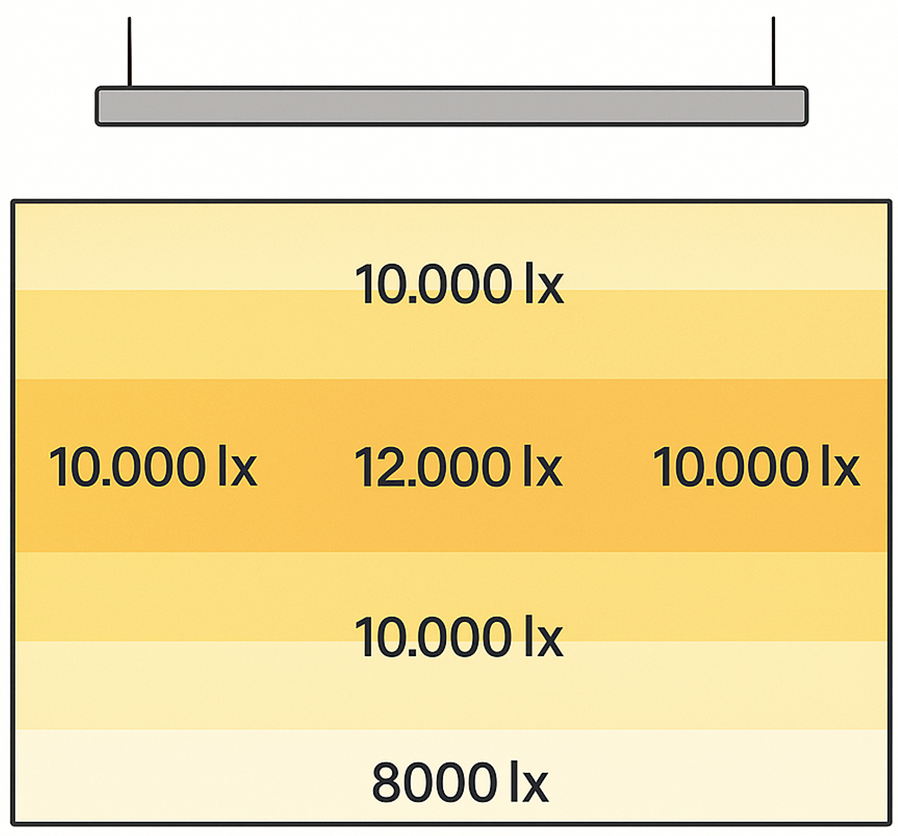
The centre of the wall receives approximately 50% more light than the edges. This gradient is a factor in plant placement decisions and complements the moisture gradient — the upper zone, which drains faster, also receives somewhat more light, further restricting it to species tolerant of both drier and brighter conditions.